Showing posts with label summer of riesling. Show all posts

Friday, September 23, 2011

Saying Goodbye to the 2011 Summer of Riesling


Final Summer of Riesling Thoughts & Link Roundup

My Summer of Riesling started right after my return from the Wine Bloggers Conference in Virginia in July. Once or twice a week I tasted, paired and shared Rieslings from all over. I tasted products from Europe, the US West Coast and several local/regional wines that came from Idaho, Ohio, Michigan, Connecticut, New York and New Hampshire.

I had hoped to finish up this week with an Ice Wine from Inniskillin but the box contained the wrong product, an Ice Wine made from Vidal instead! Not to worry, I slotted in the last bottle of a Riesling Ice Wine style wine I made in 2009. It has been a year since I had had some and it was improved once again. Intensely sweet with good acid to balance, the concentrated fruit flavors are wrapped with something I have always said was a little wild. I’m sad to see it gone, but it did make for a sweet finish.

I didn’t complete my regional quest either, and did not source Rieslings from VT, ME, RI and MA. I’ll get back to this eventually.

A few wine tasting notes never made it into any of the posts included:

Trimbach 2007 Riesling – I found this wine to be a bit too dry, maybe losing something with age. It still tasted good flavor-wise, but was more dry than I had recalled from prior tastings.

Chamard 2011 Riesling – the fruit was sourced from the Finger Lakes in 2010 for their first ever Riesling. It had the signature minerality in the nose with peach, green apple and citrus in the nose and mouth. It was refreshing but might have suffered from a lack of acid. From Connecticut.

Here is a link round-up of all of my Summer of Riesling posts:
Riesling Hour Tasting Notes

Last night I participated in the Riesling Hour event to usher in the 2010 Rieslings from the Finger Lakes region. I received a selection of six wines from the 30 participating wineries. One of the most interesting things that came out of my participation in the event was the sharing of thoughts on wines with others who received something different. I think it enhanced the conversation. I opened 4 of the bottles, leaving two I had on my recent trip in the cellar for another day. Two were dry, one was semi-dry and one was medium-sweet.

Anthony Road 2010 Dry – I ran out of time on my trip and didn’t end up getting to Anthony Road so I was very excited to get this bottle for the Twitter tasting. I found intense minerality in the nose with some wet stone & citrus on the palate. I also got hints of green apple and melon rind. I didn’t find this wine to be as good others I recently tried and was left wondering if the 2010 vintage was a bad first taste. I’ll be returning to the region soon and Anthony Road is on my list to visit.

Swedish Hill 2010 Dry – Orange and wet stone aromas. Hints of sweetness in the nose, although it drinks dry. Peach with a bit of tropicality on the palate. The acidity was pretty healthy and made me think of some of the 2009’s recently tasted. This was my favorite of the night.

Atwater Semi-Dry 2010 – The nose on this wine was the most pronounced of the four I tasted. Peaches and tropical fruits were clear and big. The flavors were consistent. This wine drinks sweet, but the finish has a drying quality to it that buffered the sweetness very well. At 10.8% ABV this wine could be a dangerous casual drinker!

Lakewood Medium-Sweet2010 – Saving the sweetest for last my palate was primed for something with a bit more sugar. I picked up pear and citrus both in nose and mouth. The wine is sweet, but again has enough acidity to prevent it from tasting flat or too sweet.


Digging Deeper into the Finger Lakes Riesling Story

During the Riesling Hour TweetChat Richard Auffrey, aka thePassionate Foodie (@RichardPF), asked a characteristically probing question, and one that got me thinking. The question was:

"What does #FLXWine Riesling offer, if anything, that you cannot find in Alsatian/German Rieslings? #RieslingHour"

There was a bit of protest about the comparison being made in the question, and I get that. The Finger Lakes isn’t Germany. But what if the question isn’t meant in a punitive or negative way? I defend the question with the idea that digging a little deeper is the hallmark of best writers in this business. Richard consistently demonstrates this, giving me and others something to aspire to.

Austria, France and Germany are the gold standard for Riesling in the world and have a long history backing up their wines. Most winemakers of Riesling know this and inevitably use the examples from these countries as guide, consciously or not.

This is not an easy question to answer because most of the assertions I came up with are of subjective value. There is no discrete answer.

Here’s my opinion on what the Finger Lakes Rieslings offer and why we should pay attention:
  1. For a young winemaking region a lot has been accomplished in 50 years. The quality presented today is at a premium to the time required to get there, and is only increasing. More time equals more quality, and the best producers are rising to the top.
  2. The very best Rieslings from the Finger Lakes rival the quality of some of the foreign competition. I said some, and the low quality stuff is easy to beat. This isn’t apples to apples so this comparison breaks down easily. But give it time.
  3. It is a domestic product so we get to wave the stars and stripes when we drink it. Some people don’t care about this, but I do. In my experience the Rieslings from the Finger Lakes are better than all of the cheap, high-volume domestic offerings I’ve tasted so we’ve got a gem here to promote.
  4. It’s a local/regional product for many consumers whose patronage supports small American businesses. Being local can also mean it is greener because it has to travel shorter distances to get to a happy consumer. Because of the increasing quality there is the two-for-one benefit of supporting the small businesses AND getting a great drink! I try to drink local in New England and with greater diversity in quality it isn’t as easy for me to get that same benefit. I felt it firsthand on a recent trip to the Finger Lakes and it got me jazzed up!
I look forward to other opinions on this topic, I am sure I will learn something!

Recent Finger Lakes Posts from Blogging Friends

The 2010 Finger Lakes Rieslings Have Been Released – LifeOfVines blog by Marie Payton

Riesling Hour – 2010 Finger Lakes Rieslings – WiningWays blog by Lorie Perrone

What to Know About 2010 Finger Lakes Rieslings – New York Cork Report by Evan Dawson

Welcoming the New Season

With summer behind us Riesling won’t be as frequent of a friend in my blog as it has been, but only because there is room here for everyone!

Upcoming highlights include two Harvest & Pumpkin beer shootouts, an all New England wine tasting and food & wine pairings befitting the cooler weather.

Cheers!

Jason

Disclosure of Material Connection: I received one or more of the products or services mentioned above for free in the hope that I would mention it on my blog. Regardless, I only recommend products or services I use personally and believe will be good for my readers. I am disclosing this in accordance with the Federal Trade Commission’s 16 CFR, Part 255: “Guides Concerning the Use of Endorsements and Testimonials in Advertising.”

Tuesday, September 20, 2011

Finger Lakes Riesling


For my celebrations of the 2011 Summer of Riesling I included several Finger Lakes selections. There were a couple of motivations for this. First off a regional source supports drinking local, a renewed passion of mine. Secondly, I would be capping off my exploration of Riesling with a visit to the Finger Lakes in September, and I wanted to do a little homework beforehand.

The first three Finger Lakes Rieslings I tasted this summer were the Salmon Run 2010 Dry Riesling from Dr. Frank Vinifera Wine Cellars and the Reserve 2009 & Semi-Sweet 2008 from the Six Mile Creek. I wrote about the Salmon Run wine in my Summer of Riesling Kick-Off where I also listed all the wines and plans I had for the remainder of the summer. As part of my homework I sourced a range of wines from Six Mile Creek to get more familiar with what is going in the Ithaca area where the WineMaker Magazine Conference will be held in 2012. My reviews of those wines are available in the post Six From Six. Both the Salmon Run and Six Mile Creek offerings made a second appearance at our Summer of Riesling Party where we held an Other 47 blind tasting of Riesling.

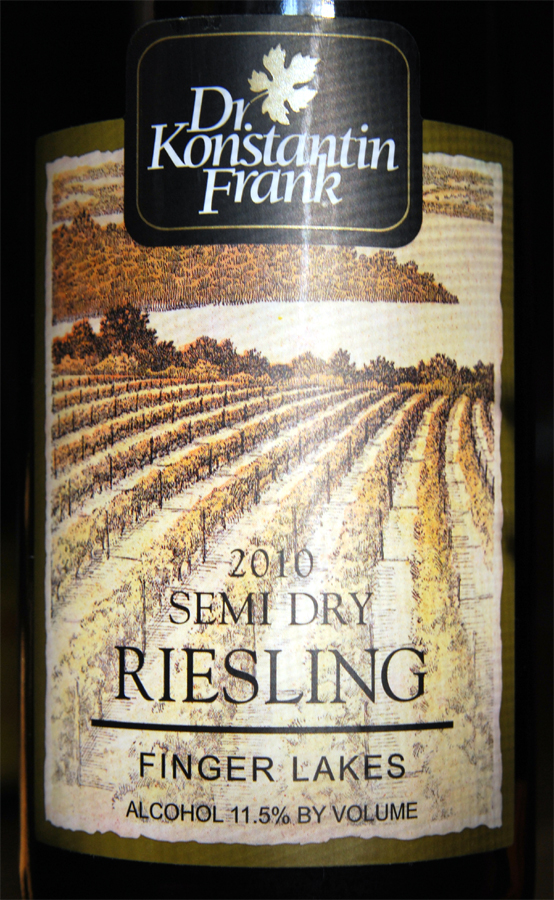
I also enjoyed a Dr. Frank 2010 Semi-Dry Riesling in a flight with a dry Riesling from Sharpe Hill in Connecticut and a Late Harvest style Riesling from Grand Traverse in Michigan. Contrasting those three styles next to each other was very interesting! 

My impression from both the dry and sweet styles is that the wines are very aromatic, fruity with plentiful minerality and acid that keeps the wines fresh and crisp. With such a limited tasting I couldn’t conclude anything else, except that I enjoyed the wines and would be looking forward to trying more when I visited.

I will be finishing my Summer of Riesling celebrations this week with a couple of activities. First off, I saved a bottle of Inniskillin Riesling Ice Wine for my final review, a sweet finish to be sure. On Thursday I will be participating in the Riesling Hour virtual tasting, an event held to ring in the 2010 vintage of Finger Lakes Riesling. The sample wines I received for that event included a few I tasted while on my trip, reviewed here, and several wines that are new to me. The added depth from the new selections means that I will have surveyed more than 20 different Rieslings from the region this summer, giving me a good foundation to confirm the prevailing wisdom that Riesling is done very well and is the signature wine from the Finger Lakes.


You can find semi-sweet, late harvest and iced style Rieslings in the Finger Lakes, and while there is nothing wrong with those styles (the late harvest can be divine), the dry Rieslings are the wines that show the most finesse.

Why does Riesling do so well in the Finger Lakes? In my post where I shared what I’ve learned about the region at-large, About the Finger Lakes, the geologic, weather and micro-climactic forces that make the region what it is were broadly presented. These forces are part of the reason. The other part is the people, and specifically people with experience from some of the great Riesling-making regions of the world who came to the Finger Lakes and have demonstrated what is possible with the grape. Their experience has helped others experiment and learn with similar results.

The Rieslings tasted on the trip that can be broken down categorically by dryness with the following stats:
  • Dry - 13
  • Semi-Dry - 6
  • Late  Harvest/Dessert – 1

Overall the wines were sound with no obvious flaws. I would drink all of these wines again and would recommend visitors to the region seek them out for the firsthand experience. One specific experience tasters should plan on trying is contrasting the same producer in difference vintages and from different vineyard parcels. There will be variation for a number of reasons and experiencing them adds depth to your understand what is possible.

Best of the Best

Hermann Weimer 2010 Dry – this wine presented stone fruits and citrus in the nose with the same flavors coming through on the palate. The hints of grapefruit on the finish accentuate the healthy, but balanced acidity of the wine. Everything about this wine was clean and focused, making it shine.

Rooster Hill 2010 Med. Sweet – The golden plum that came through in the nose on this wine was very specific and pleasant. The hints of gravel and petrol that accented the plum were in just the right place. I picked up baked apple, and peach in the mouth with citrus coming in for the finish. This was the one I felt had the broadest aroma and flavor palate, offering lots of things to discover in each sip.

Ravines 2009 Dry – This was the wine where I felt finesse through understatement was best demonstrated. There was peach in both the nose and mouth, perceptible minerality and a tart, clean finish.  Calling this wine simple is totally unfair, and subtle and aloof convey more of connotations I am going for. If I were going to pick one of the Rieslings I tasted to have on hand all the time, this would be it. Why? Because its finesse and subtlety make it useful in the widest possible circumstances, a necessary attribute in a house wine.

Most Notable Single Vineyard Bottling

Heron Hill Ingle Vineyard 2008 – grape growers and winemakers in the Finger Lakes region manage a patchwork of vineyards that lend significant and demonstrable differences in the final product. When a specific source is found to be particularly interesting and is used to produce a wine, the result can be so much more than if the same fruit were blended in with others.  The Ingle Vineyard 2008 Riesling tasted like applesauce! With 1.64% residual sugar it has just enough sweetness to accentuate the apple and spice. A bit of minerality and petrol in the nose balanced all the other facets to create a beautiful single vineyard Riesling.


Notable Vintage and Parcel Differences

Glenora 2009 Dry Riesling versus the 2010 Dry Riesling. I found the 2010 to be signinifcantly more vibrant, aromatic and flavorful than the 2009. Hearing that the growing season for the Finger Lakes in 2010 was the warmest ever and that there had been mounting expectations for the wines made from it, this would be a consistent finding.

Keuka Lake Vineyards Evergreen Lek vs. Falling Man Vineyards. The Evergreen Lek wine had mild aromas and a lime driven finish. Opposing that, the Falling Man wine presented aromatics of unripe peach and had a bit of funk to offer as well. Both wines offered juicy acidity and pleasant palate. With a finish also driven with citrus, but not so much lime, the Falling Man selection was the better balanced of the two, offering a nose and palate that complimented each other best.

Other Highlights

Tierce Riesling – this collaboration between Red Newt (where we tasted it), Fox Run and Anthony Road is a great example of companies who are technically competitors joining forces to combine the best each has to offer and take it higher.  The wine had a pleasant balance of peach & citrus, minerality and high, but refreshing acid. Products like this are largely unheard of in other regions. May this be the beginning of a new era in wine!

Beautiful locations to sip a Riesling - I was taken with the views from the tasting rooms of Dr. Frank, Heron Hill and Damiani. A common thread was floor to ceiling (or close to it) windows looking out over the adjacent property, vines and ultimately the lake. The vines that were full of vigor and fruit at Dr. Frank’s made for a particularly beautiful vista. Wine is very much about a place as many wine-knowledgeable people know, and where you taste is absolutely part of it.


Producers We Missed on This Trip

Anthony Road Winery – having taken the Governor’s Cup for their 2008 Dry Riesling this is one missed visit that I will be sure to right on my next soon to be planned trip. Adding a component to the Tierce Riesling is yet another attractive draw.

Fox Run Vineyards – collaborating on the Tierce Riesling is all I need to know to have this stop on the itinerary for next time. Good wines, a good story and a passion for collaboration to grow the esteem of the region vote high in my book.

Conclusions

My conclusions are simple. Go to the Finger Lakes, try the Rieslings and then reflect on what more the experience tells you about the place and its people. You won’t be disappointed, and you won’t be able to hesitate telling others to follow in you footsteps. There are plenty of other wines that are worthy of your time, and I will be sharing those here real soon, but the Rieslings define the region.

Cheers!

Jason

Wednesday, September 14, 2011

Summer of Riesling Pairing – Chilean Sea Bass & Chateau Ste. Michelle Dry Riesling


The 2011 Summer of Riesling is winding down, but I’m not quite finished yet! This week I paired the Chateau Ste. Michelle (CSM) 2009 Dry Riesling with a pan roasted Chilean Sea Bass for some late-summer magic.

Dry Rieslings are very versatile wines, pairing well with a wide range of flavors and textures. Without the sugar of their more casual drinking oriented peers these wines are easy partners with savory dishes that don’t go too heavy on sauces or earthy flavors. I wouldn’t try to put a dry Riesling up against a steak or pasta dishes with lots of red sauce, but I would go out on a limb with spices, white wine braises, salads and as I did this week, fish.

I had never had the Chateau Ste. Michelle Dry Riesling before opposed to being no stranger to their sweeter wines. The standard CSM off-dry Columbia Valley Riesling is the first wine that both my wife and I can remember drinking together who knows how many years ago! We visited CSM in 2010 during our extended trip out west for the WineMaker Magazine conference in Stevenson, WA. Moving beyond the Rieslings we found single vineyard gems like the Wahluke Slope Syrah and the Canoe Ridge Merlots, including the Ethos Reserve Merlot that really knocked my socks off. I’ve enjoyed both the Indian Wells Cabernet and Eroica Riesling several times, and highly recommend all of these wines if you want to see what CSM brings to the table as a winery.

The wine pours a light gold color and brilliantly clear. It offers up peach and tropical notes in the nose, with a hint of petrol to round it out. In the mouth I picked up much more peach and citrus, with the citrus riding along for the finish. I did experience some sulfur aromatics during a few sips, but it wasn’t consistent. The wine is nearly dry with 0.76% residual sugar so just a touch of sweetness comes through if you focus on it.

Preparing Chilean Sea Bass at home was another first for me. This could also be the first time I have ever had it as well, but I can’t specifically remember whether I have had it or not, so I won’t make that claim.

The preparation of the fish was dreadfully simple. I started by slicing half of a white onion, half of a red pepper and thinly slicing two small garlic cloves.  I also preheated the oven to 450 degrees. The veggies were sautéed in an oil coated pan just until they began to wilt. I deglazed the pan with dry sherry and then added vegetable stock, salt and pepper, cooking it until it thickened. While the sauce thickened I heated a cast iron skillet over medium high heat with a tablespoon of oil until it just started to smoke. I salted and peppered the clean fish and placed it in the skilled skin side down for 4 minutes. After four minutes I flipped it, allowing it to sear for 1 minute longer. I then transferred it to the hot oven for about 2 minutes until the fish was a healthy golden brown. To serve the fish I placed half of the vegetable mixture on each of two plates, laying ½ of the fish on top of the vegetables. I light dusting of salt and pepper is all that was required to season it to taste.


The fish melted in my mouth like butter and the nuance from the sherry and stock in the vegetables was a killer combination. The wine accented this dish with the fruit flavors and a touch of acid to make everything pop. I honestly believe this is one of the best food and wine pairings I have ever executed, one I will look forward to repeating and riffing on in time.

Next week brings the end of this ride for 2011, but not without some renewal . On Wednesday I am going to taste and share the Inniskillin Riesling Ice wine for my sweet finish. I’ve had this wine before and drool every time I think about having it again. On Thursday I am going to participate in the Riesling Hour virtual event which heralds the arrival of the 2010 vintage of Finger Lakes Riesling. Having just returned from the Finger Lakes I have several 2010 bottles to choose from when I go to raise my glass!

Cheers!

Jason

Tuesday, September 6, 2011

A Taste of “The Other 46” for the 2011 Summer of Riesling


At the 2011 Wine Bloggers Conference participants had the chance to taste wines from “The Other 46”, which is this case was open to wines from states other than California, Washington, Oregon and New York. I seized on this opportunity and tasted as many of them as I could. Wines from Missouri, Ohio, Maryland, Texas, Indiana and our host state Virginia were poured. To me this was the ultimate experience of exploration, tasting wine from states that have a local reach that I might not otherwise easily have the chance to try.

It was with the above approach that efforts from both my mother (thanks Mom!) and I culminated in the organization of an Other 46  / Summer of Riesling tasting of wines at home. I exempted my own state, NH, swapping it out for New York in lining up wines, with the states of New York, Michigan and Connecticut represented in our tasting. As I mentioned in my recent posts from my one-day vacation to Maine, I was not successful procuring Riesling from  that state, and slow progress in sourcing Riesling from MA, RI and VT means that I am at risk of not finishing my tour of New England for Summer of Riesling, but I’m trying!

No casual wine tasting is complete without some snacks. As you can see from the picture below, we did pretty good this time! Parmesan, Grafton Village Cheese Smoked Cheddar and Berkshire Blue were paired with peaches, strawberries, apples and crusty bread for a wide range of earthy and fruit flavors to pair with the wines.


The first wine was the Sharpe Hill 2005 Dry Riesling from Connecticut. The nose had a petrol element to it that I was quite surprised to find in a Riesling made outside Europe where I typically detect that aroma. I also found green apple aromas with hints of minerality. This wine is steely and stony on the palate, with minimal fruit. I conclude that the wine is showing its age, but hasn’t yet reached a place where I could say it is flawed. The finish is dry, of moderate length containing some citrus notes. This was the wine I felt has the most pronounced nose, and one I would recognize as a Riesling hands down.

I included my homemade 2008 Riesling/Gewurztraminer blend as a reference wine. Aromas of slate and sulfur were immediately found. In the mouth the wine has peach flavor, is off-dry and has a short finish. This wine is past its prime and isn’t really worth drinking.

The next wine was the Dr. Konstantin Frank 2010 Semi-Dry Riesling from the Finger Lakes region of New York State. I found both apricot and herbs in the nose. The wine is slightly sweet with the flavors of peach and citrus, where the citrus builds and lingers along the finish. The acidity in the finish makes the wine much more refreshing than the early part of the taste might suggest. This was the wine with the best balance of the three wines tasted.

The last wine was the Chateau Grand Traverse 2010 Late Harvest Riesling from Michigan. Aromas of dried fruits, orange blossoms and spices emanate from the glass. There is also a bit of a wild aroma to the wine, similar to ice wines made from Riesling grapes. Flavors of orange and peach are wrapped some residual sugar that comes off much drier than I expected it to be. There is an acidity that comes in at the beginning of the finish, but it trails off long before the flavors do.

The more Rieslings I taste the more I want to try them from as many places where it is made. Do you have a favorite Riesling that isn’t made in CA, WA or OR? Leave a comment with the name, vintage and state of origin. Who knows, I might just seek it out and try it before the end of summer!

Cheers!

Jason

Friday, September 2, 2011

Chicken & Squash Curry with Riesling, a Summer of Riesling Pairing


Food and wine pairing is fun to do in an experimental way because you never know what is going to happen and you have to be ready for both success and failure. Luckily a came out on the success side with this pairing for my enjoyment of the 2011 Summer of Riesling.

I included the Kendall Jackson Vintners Reserve 2009 Riesling based on my past experiences with their Grand Reserve Chardonnay and expectations that they produce equally enjoyable Rieslings. That’s a risk in itself, but one that as I alluded to above, I was prepared to be on either side of. As it has been with quite a few of my Summer of Riesling wines, the wine is accessible to many and has a reasonable price point, $11.99 at my local store, making it a solid everyday recommendation.

Kendall Jackson Vintners Reserve 2009 Riesling

Dry stone, apricot and tropical notes in the nose. Very light on the palate, sweet but not very at all. On the palate I picked up citrus flowers and a spicy element that moves back and forth between spices (ginger, cinnamon and the like) and minerality. The finish is smooth and clean. Overall none of the elements of the wine are pushy so a balance is there making it a very approachable wine.

The wine is not a 100% varietal bottling, and has Chardonnay, Gewurtraminer, Viognier and Muscat Canelli also in the mix. An interesting blend to be sure. KJ doesn’t bottle a straight Riesling which if available would be interesting to contrast with this wine.

The next chance I took was attempting a pairing without having had the wine yet. That’s where the fun comes in. I knew it had some residual sugar so using spices in the dish it would be paired with was the first thing that came to mind.

How about a Chicken & Squash Curry? The Indian spices would offer that zippy vector and the creamy, slightly sweet squash would get a boost from the fruit and sugar in the wine. Here’s the recipe I pulled together from several ideas and some of past experiences with making Indian food at home.


Chicken & Squash Curry

For chicken preparation:
1 lb boneless chicken, cubed
½ tsp ground allspice
1 tsp turmeric
2 tsp olive oil
Dash of salt
Dash of black pepper

For the curry:
1 large white onion, chopped
1 large red pepper, chopped
2 inch piece of ginger, minced
6 garlic cloves, minced
½ jalapeno, minced
4 Tbps butter
½ Orange Buttercup Squash, peeled, cleaned & cubed
1 Tbsp curry powder
2 tsp Garam Masala
1 tsp Thai fish sauce
1 Tbsp lime juice
1 can light coconut milk
4 oz pineapple juice
2 cups vegetable broth
1 Tbsp cornstarch & water to mix
2 Tbsp cilantro paste

6 servings of Basmati rice cooked with water and 2 Tbsp cumin seeds

Heat the olive oil in a small skillet over medium heat. Begin to brown the chicken in the oil. Add the spices and cook until no pink is visible and spices are fragrant. Remove from heat

Melt the butter in a large pot, add the onion, pepper, ginger, and garlic. Sautee until the onions begin to brown. Add the jalapeno, squash, curry powder, Garam Masala, fish sauce, lime juice and toss to coat. Add the coconut milk, pineapple juice and broth. Increase the heat to bring the curry to a boil. Once boiling add the chicken and reduce the heat to med-low and simmer for 20-30 minutes. Some of the liquid will boil off and the curry will begin to thicken. Add the cornstarch and water and increase the heat to continue to thicken it. Cook for another 10 minutes or so. Remove from the heat and mix in the cilantro paste. Serve over the hot rice with Indian flatbread and/or appetizer items like Pakora and Samosa.

The pairing of the curry and the wine really did work. Here’s why. Both the wine and food retained their unique attributes when taken together with neither of them getting smothered by the other. The spices in the curry and the sweetness in the wine were balanced against each other. The amount of black pepper (in the Garam Masala too), use of standard non-spicy curry powder and restraint on the jalapeno produced a mild curry where a good deal of spice came from the ginger. I think the limited residual sugar of the wine found a good home here. The fruit in the wine tasted great up against the meaty flesh of the squash which had gotten soft but wasn’t outright falling apart. The manageable acidity and clean finish of the wine helped with the creamy density in the curry from both the coconut milk and the squash.

A success! I was very happy with this pairing experiment and even if it hadn’t gone well, both the food and the wine have considerable merit on their own so nothing would have been lost in this.

Are you enjoying the Summer of Riesling? If not, consider taking a Riesling for a spin over the Labor Day Weekend. There are so many to choose from and quite a few aren’t the simple plonk that Riesling’s reputation often suggests.

Cheers!

Jason

Wednesday, August 24, 2011

Two for Dessert – Summer of Riesling

During my collection phase to celebrate the 2011 Summer of Riesling I found several ice wine style Rieslings that were new to me and thus offered unknown potential enjoyment. I've enjoyed two of them so far, treating them as dessert without any accompaniment.

For me late-harvest, dessert and ice wine style Rieslings are the most vibrant example of what you can do with the grape. Something about the concentration of the aromas and flavors resonates profoundly with me.

Koenig 2009 Riesling Ice Wine

This wine has the color of honey with pungent ripe and ripening fruit aromas. The fruit aromas are intertwined with honey and spices which are joined on the palate by dried fruits and a great balance of acidity and sweetness. It has a smooth, clean finish that lingers but not to extremes.

Riesling Ice Wine from Idaho can hang with dessert wines from many other areas based on my experience. This wine is polished with pronounced aromas, flavors and some wild nuances that make great North American dessert Rieslings shine.

I ordered this wine directly from the winery with a couple of other styles, and it retails for $20 per bottle. That makes it good performer for dessert wines and an average performer overall.

Pacific Rim Vin de Glaciere

Hailing from Washington State this wine is a solid pleaser with a very specific fruit focus. Oranges. This wine is golden/orange in color, has aromas of citrus in the nose and flavors of dried oranges on the palate. It is hyper-orange, but in a balanced way where enjoyment of it isn’t hard. The acidity that rides along the finish does a fine job of leaving a clean exit. I bought this at a state liquor store for $18. Again a good performer in the dessert wine category.

Both of these wines would make fine ends to an evening with cheese, dessert or on their own. You have to like dessert wines to enjoy these, but I am hoping if you’ve read this far that you would be in that group.

And with that my 2011 Summer of Riesling continues. The search for Rieslings from the remaining New England states has seen some setbacks with my recent schedule, but with about a month to go until the technical end of summer, I’ve got time. I am expecting several additional events, including another regional Riesling tasting (New England wines) with my family in a couple of weeks, several more food and wine pairings, two more selections from Europe; capping it all off with another tasting of the exceptional ice wine from Inniskillin, a product of Canada.

Cheers!

Jason

Saturday, August 6, 2011

Everyday Wines to Celebrate Summer of Riesling With

So why I am writing about Riesling? I know amongst hardcore wine nerds most of it doesn't have a lot of cred, and furthermore when you write about the mundane and easily available selections you find a lot of even minimally wine-educated people aren't interested.

I am writing about Riesling for a couple of reasons. First off, I like a well made Riesling so trying them is part of my journey. The most compelling impartial reason is because so many people drink Riesling when they first explore wine and some people never move that far because they like what they are drinking. I see a great opportunity in that. I count a lot of food bloggers in my audience and I know from interactions that they aren’t always wine-knowledgeable and are often just getting started. In one of Joe Roberts’, 1WineDude.com, most recent posts he presents a graphic (courtesy of VinTank) about the pyramid of wine consumers and how companies looking to really engage serious wine drinkers are picking from a much smaller group than might otherwise be thought. The same pyramid applies here when strictly applied to the tastes of the wine drinking community at large. The difference for Riesling (vs. online apps for wine & social media interaction) in my experience is you end up with more of the bottom of the pyramid in your audience. If I can share my experiences with these wines it will help people tasting them better appreciate wine and grow their palates, something we all enjoy!

Writing about both easily available (and likely large volume, average quality wines) AND smaller batch, higher quality wines is an attempt at showing the broad picture when my experiences are taken together. There is a lot of Riesling out there, some is passable, some is worthy of frequent drinking and the very best are worth a quiet sip and savor. That’s the forest. The trees will be the details when each of the wines and styles is approached, tasted, paired and reviewed.

Last night I lined up three Rieslings that I could easily obtain at a local store, all with price points under $10 at the time I purchased them. The wines hail from Germany and Australia, two places where value Rieslings are commonly made. Germany clearly has the advantage over Australia in the higher quality, dessert and ice wine style Rieslings, as well as with history of wines made from the grape!

The first is the Dr. L 2007 Riesling. This is the entry level wine from the Loosen Brothers and plentiful at release time each year. When I bought the 2007 some time back I had several enjoyable drinkings and I left one bottle to age with some growth potential in mind.

Intense aromas of tropical & stone fruits, and dry stone minerality. Huge punch of acidity at first, with a sweetening in the middle and a tart citrus-infused finish. It is drier than at release time, but in a pleasing way and not expressly detracting from the wine. It is classically structured with a touch of age.

The second wine is the Lindeman’s Bin 75 2008 Riesling. I know I’ve had this wine before, but I expect it was more than 6 or 8 years ago and I don't have a recollection of it. I’ve enjoyed my share of Aussie Rieslings so I am looking forward to returning to one from days gone by.

Nose of fruit with chemical and alcohol aromas. Dry as expected. Acidity isn’t moderated by any sweetness and it projects an intense lemon flavor in the finish. Not balanced well enough to be hugely enjoyable.

The final wine is the Relax Riesling 2006. This bottle is everywhere! I don’t know how many times I have seen this bottle at parties and I’ve only had at friends’ houses a few times here and there. I recall it to be an easy drinker, but nothing more.

The nose here is the most outright complex, with aromas of lychee and plum and a slightly dried fruit or spiced fruit bent. Medium-dry but not quite balanced. The 2006 had made me think I might have lost track of this bottle a bit too long. It is still quite refreshing, and pucker-inducing as well!
  
I skipped back to the Dr. L when I was done for one simple reason, the wine is balanced, but is declining, and while not wowing me is the most interesting of the bunch. This is the wine I have the safest recommendation on, and the 2009 vintage is supposed to be better than 2007, so who knows how much you might like it too!

I found the initial serving temperatures of all the wines to be a bit high and chilled them down a bit and came back again.  The Dr. L perked up nicely with the drop in temperature. The fruit was more pronounced and the sweet/tart balance was better. The Lindeman’s projected a more focused nose of grapefruit and minerality but I didn’t see a bump in the taste. They nose on the Relax was also enhanced and the pucker-inducing affect was a bit subdued.

So overall my experiences were mixed here and the Dr. L is the clear everyday drinking winner from this bunch. Furthermore when purchased soon after release and in a good vintage (2009) this wine has a price/performance ratio that can’t be beat! I’ll have to find newer Lindeman’s and Relax bottles to taste and see if my experience were typical or not.

And with that Summer of Riesling rages on. Check out the events that might be going on near yet on line.

Cheers!

Jason

Thursday, July 28, 2011

Kicking Off Summer of Riesling

I heard about the Summer of Riesling (#summerofriesling) after last’s year’s edition. The buzz about it being bigger from the prior year and with more wines from different regions peaked my interest.

This year I knew that I could write a number of posts about Riesling that included our friends, reviews, food pairings, stories and promotional events. Earlier in the summer I was busy with the Relay For Life (raised $10K again!) and the pre-conference networking for #WBC11. I had been accumulating bottles slowly the whole time and still have a few, primarily New England producers, to purchase. I have no idea what I am going to do when I feature Riesling for the rest of the summer, I am just going to get inspired to create something interesting each time.

To get things rolling I offer a dinner pairing of a Grilled Salmon (recipe below) and the Salmon Run Finger Lakes, NY 2010 Riesling. There are two things about this wine that prompted me to include it, first it is dry and I wanted to start with a wine that demonstrates the falsity of the sweet Riesling myth. Secondly, I had this wine with a particularly good meal at the Granite Restaurant in Concord, NH a few years back. The dinner was an anniversary celebration for my wife and I, and one not long after my cancer treatment, so one we enjoyed with a newfound appreciation of what we had for sure. I wouldn’t have considered the wine as closely then and I was curious what I would think now.

Salmon Run 2010 Riesling

Aromas of pear and melon. Flavors of pear and green apple. The acidity is intense and the resulting steely sensation is a great attribute. The finish is pretty long with citrus pulling up the caboose. The wine is currently on sale at the NH Liquor store for $11.99.

The pairing of the salmon and the dry Riesling was a really great call. I’ve used sweeter Rieslings for spicier grilled salmon, but here the dry wine saw its fruit extended by the fish, with the creamy texture of the fish melding with the acid in the wine perfectly. I’d serve this again for sure!

The rest of my list is as eclectic as it is a workable survey of widely available and affordable wines. The regional wines are more common at their local level, but some do sell beyond.
  • Kendal-Jackson Vintners Reserve 2009
  • Loosen Brothers Dr. L Qba 2007
  • Inniskillin Riesling Ice Wine
  • Ferrante Winery 2010
  • Relax 2006
  • LaBelle Winery 2009
  • Koening Winery 2008
  • Trimbach 2007
  • Pacific Rim 2007 Vin de Glaciere
  • Allenhofen 2007
  • Chateau Ste. Michelle Dry 2009

I still have to buy these
  • Australia – looking for something dry
  • Vermont – already looking for suggestions
  • Massachusetts - Westport Rivers
  • Connecticut – Sharpe Hill
  • Rhode Island – Newport Winery
  • Maine – I am going to be in Maine in a few weeks and will pick one up
So with that lineup I have all of the New England states covered, with the states of California, Idaho, Ohio and Washington represented as well. For countries we have Australia, Canada (QC), France (1), Germany (3) and of course the United States. That is a pretty adventuresome list with vintages form 2006 to 2010, and from dry to sweet and dessert styles.

So a couple times a week now Riesling is going to make an appearance. Are you enjoying any of the Summer of Riesling on your own? There are bars and restaurants all over with event-specific menus and wines lists with more Rieslings to pick from than usual. Check it out, you won’t be disappointed!

Cheers!

Jason


Grilled Salmon Recipe

1/3 cup soy sauce
¼ cup water
¼ cup vegetable oil
1/3 cup (minus 1 tsp) brown sugar
Dash of Chili powder
1 large salmon steak
Meyer lemon sugar
Salt
Pepper

Mix the first 5 ingredients. Salt & pepper the fish. Marinate the fish for 2 hours. Grill or broil until cooked.