Showing posts with label homebrewing. Show all posts

Tuesday, May 7, 2013

Now Hear This – Kid Rock Helped Me Make Better Beer


( Us from the night in question. )

Where: Somewhere in the Atlantic Ocean onboard the Carnival Destiny cruise ship
When: April 2012,  late at night
What: Me joking that I could create a lime-infused ale that is better than Bud Light Lime, not that that is really that hard…

I’ll be honest, I struggled to find what I personally consider worthy beer options at the bars while on the Kid Rock Cruise. If you are a Chillin’ The Most cruiser and are reading this, take no offense. I make my own beer and over the years I have lost my taste for the big three brands (Bud, Miller, Coors), but I believe people should drink what they like. Drink freely my friends.

During one of the evenings on the cruise Margot and I sat outside enjoying both the warm night air and the people watching. The people watching on the cruise was epic by the way. I hit the bar and decided on a couple of Bud Light Limes. As I was drinking my beer I remarked “hey this isn’t so bad” and began talking about how I might craft something similar at home. Margot was goading me on, asking me to express how I really felt about Budweiser and got it all on video, but the video isn’t SFTB (safe for the blog) so you’ll just have to imagine it.

As I thought about it over the remainder of the weekend I figured a basic American ale containing both wheat and corn would be a solid blank slate to layer on some lime. Having worked with citrus flavors in my home fermentations before I knew that a multi-phased approach would work best. I added dried lime peel to the hot wort just before I chilled and strained it, and then fresh lime zest after I transferred the beer to the secondary fermentation container. Finally, lime juice was added at bottling to help bring it all together and lock a solid zip of lime into each bottle.

My plan worked. The beer was brewed on July 4th, 2012 and we set about enjoying it about a month later. We actually used the same beer base to make a lemon shandy, a beer that went on to take a first place in a brewing competition later in the year. But I digress.

Everyone who tried the lime ale had positive words for it, and some people drank every bit of it in sight each time I chilled some down. It is a light-bodied beer and early on the effect of the corn was not very apparent. We just drank the last of the batch this past weekend and just like when I’ve brewed with corn in the past a rounded, sweetness developed with age. In the first few months after the beer was brewed the lime complex in the beer was potent, adding considerable tartness and crispness to each sip. Nearly a year later the lime was much mellowed, but still present.

Skip to the current day. I brewed a fresh batch of lime ale on my birthday last month, nearly one year to the day I hatched the plan in the first place. The recipe for the beer (provided below) has been slightly modified, but the first dose of lime (dried peel) was added at the same time and the fresh lime zest will be as well. At bottling however I will be using more lime juice, and all of it freshly squeezed rather than bottled. 

Getting an earlier start on the second batch means it will be conditioned and ready to go for the summer drinking season, where I expect it will be consumed even more quickly, meaning I won’t be able to say I finished the last of it ten months later.

As for Kid Rock, he needs to get his ass to my house to try the creation he inspired. If you are reading this Bob (I’m dreaming, but one has to do that now and again) the invitation is open and we can retreat to the basement with openers and straws and see what comes of it!

And with that I’ll leave you with a video from the sail away show from the Kid Rock Chillin’ The Most Cruise #3. I can still hear my favorite Kid Rock songs reverberating across the sand and sea while I stood in the sun enjoying the simple things in life, like when and where.

 ( This video is not my own, but it kicks ass so I shared it! )

Cheers!

Jason


Ancient Fire Lime Ale 2013

SRM: 4.6
OG: 1.050
IBU: 14.5
Mash time: 30 min
Boil time: 45min

4lb Pilsner Dry Malt Extract
1lb CaraPils
1lb Flaked Wheat
1lb Flaked Corn
1oz Hallertauer hops (45 min)
0.5oz Cascade hops (5 min)
0.0oz Cascade hops (post boil, 5 min)
1oz dried lime peel (post boil, 15 min)
Zest of 6 limes (secondary, until bottling)
Lime juice (amount TBD, at bottling)
Maurivin brewing yeast, 1 liter starter

Wednesday, April 3, 2013

Home-brewing Is Messy & Noisy But Is So Worth It!

I've been home-brewing nearly ten years now and several things have been constant during my experience. The mess and the noise. I am going to cast these ideas specifically in terms of making beer,  something I am doing a lot of in 2013, but my experiences with making mead, cider and wine are very much the same.

Home-brewing is messy. I make more of a mess and spend more time cleaning up than I do actually brewing. I brew with extract, although I have switched to a partial mash technique and dry, versus liquid, extract in the last year or so. Dry malt extract is a funny substance. It is a fine powder so it kicks up dust pretty easily which means I usually end up with a small coating of it near my scale and vessel I am measuring into. Even a small amount of moisture, steam for example, turns the dry malt extract sticky, and if you don't get any excess wiped up quickly it dries and is oh so fun to clean up!

Wort, unfermented beer, is another messy character. Having blended water, malt & hops together this should be no surprise. Spilling wort in the wrong place can create a nice mess and having a boil over during the initial brewing can be a real pain to clean up. I watch my brewpot like a hawk and I haven't had a boil over in almost 3 years now. That last time I did have a boil over I had to wait until it dried so I could de-clog my burner. That was a huge buzz-kill on that brewday! I've never taken any pictures of these types of messes so I can't share the visual. If you've ever experienced it firsthand you know what I'm talking about!

Cleaning in general is the part of home-brewing that will always consume a huge amount of time. Equipment is cleaned & sanitized before you use it (the pic above is a table full of cleaned equipment) and then again afterwards before is it put away for the next brew session. That means lots of time at the sink, the application of several kinds of cleansers and sanitizers and a fair bit of both hot and cold water. My cleaning work always takes a toll on my hands and until the day is done I can't put anything on them because it would transfer to the equipment that I am trying to get or keep clean.

None of this is really a burden and I am not complaining about any of it, but a bit of honesty in pursuit of homemade beer can at least ensure folks new to the craft know what to expect. With experience you can mitigate the effects of the mess and manage the cleaning so that you can enjoy standing around the brewpot in the sun with a tasty homebrew.


Less of a labor-inducing issue but still constant is the cacophony of sounds released by home-brewing. Propane burners, boiling wort, air locks & blow-off tubes are just some of the sounds. For folks that use pumps and more sophisticated brewing rigs I bet there are other sounds I am not accustomed to from my low tech approach.

The last several high gravity (more sugar) beers I have made required a blow-off tube that was terminated in a pitcher of water. And boy did they make a racket! One of them is still going along albeit at a reduced pace from 10 days ago when it was brewed. I went down to the basement at one point and didn't initially know what the gentle pounding on the ceiling was. It was the CO2 being expelled into the pitcher from the fermenting beer on the floor above!

I took a short video of that recent brew on the second day of fermentation. If you watch closely you can see the bubbles being expelled into the pitcher, but with the sound on and the volume up you can also hear the noise it makes. Luckily you can really on hear it in the adjoining rooms on the same floor and as I mentioned from below in the basement.


Now that I've carried on a bit about some of the joyous challenges of home-brewing you might be wondering what I have been making and what is on the future brew schedule.

So far in 2013 I have made the following brews:
  • English Barleywine
  • Double IPA
  • Belgian Style Braggot
  • Moylan's Kilt Lifter Clone (a Scotch Ale)
  • Stout Braggot (currently in a used whiskey barrel)
  • Maple Wheat Wine
  • Belgian Dubbel
The Belgian Style Braggot and the last three above are still fermenting and/or aging.

Over the winter I also created three mini-batches of braggots (mead/ale hybrids) that also contained fruit or cider. All three have been bottled and two of the three have sampled well. My primary takeaway was that a light ale based braggot with fruit, like raspberries, is a nice beer; but the honey might not be best used in this way. The cider-based versions have a sour tinge to them, something that might not find a happy home in a broad audience. Interesting experiments nonetheless.

We are switching over to brewing lighter beers for Spring over the next month or so, which includes:
  • Orange Wit
  • Lime Ale
  • Double Pilsen Ale
We are also going to need to fill our two new barrels again soon so we have a Russian Imperial Stout (our first ever) and a Smoky Chocolate Ale on the schedule for that purpose.

( One of our one-used whiskey barrels from Balcone's Distillery in Texas. )

As you can see we are quite busy with the home-brewing right now!

All of the work is worth it, especially when you get to share your homebrew with friends. I usually forget all the hard work in between brewing sessions so I don't grow anxious about my next one.

Cheers!

Jason

Friday, March 22, 2013

My Half Full Glass - March 21st, 2013


After a month-long break I am trying to get back on terms with my weekly posts. Some things have calmed down and others stay as insane as they were when they knocked me off track. Such is life!
This week is a celebration of drinking local with both a locally made spirit and a local mead. Do you drink local?

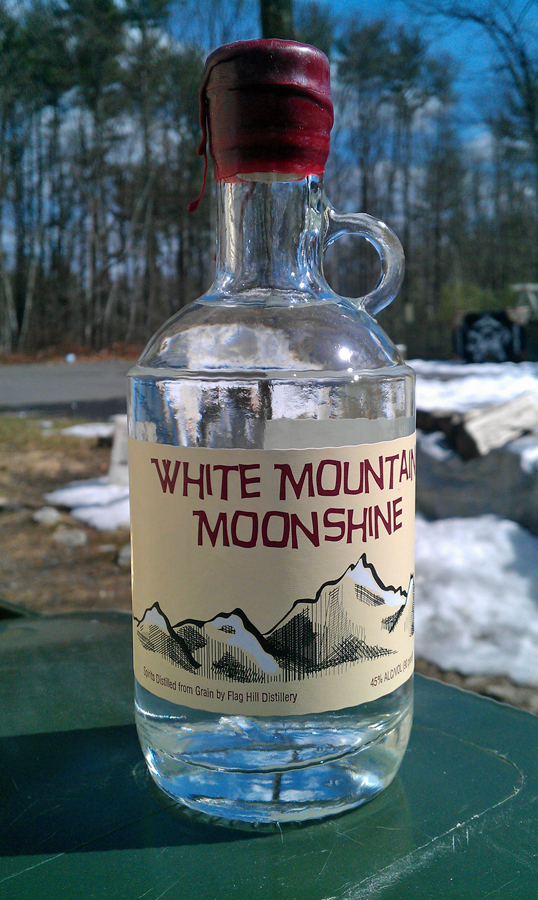
Flag Hill Distillery White Mountain Moonshine

I took my first sip of the Flag Hill White Mountain Moonshine whilst outside brewing a pot of beer on a sunny yet cold & windy day. I am sure the environment had something to do with my first impressions, but since they were quite positive I think the setup only ads to be mystique of drinking local moonshine!

I don't have a lot of experience with white/un-aged spirits so I don't really know how to describe them very well. The nose definitely has a punch of alcohol and reminded me of high proof vodka. The more I thought about it the more I realized that there is a greenness to the nose which I can only link to the corn and  gently malted barley being un-hidden by barrel aging. The nose is slightly sweet, but not abundantly so.

In the mouth this drink is sweet, and at 90 proof it does warm quickly, but there is not the harshness or burn that you do find in undiluted 'shine or white dog that you might get served out of an unlabelled container.  Some of amount of grain flavor was accessible to me, but I again don't feel qualified to say much more about it.

Because I was around the brewpot I thought of other communal functions where this tipple, and the cute little 375 ml handle bottle is just really cool, might fit in well. Campfires and cigar night with the boys both came to mind.

I purchased this at my local NH Liquor Store at $18.99 for the 375ml bottle. Yes that is a bit pricey, but I know, like and appreciate what the folks at Flag Hill do so it was worth it to me.

Sap House Meadery Vanilla Metheglin

I got some cheerful personal mead-making news this week in the form of a silver medal at the 2013 Mazer Cup for my vanilla mead. Realizing I hadn't sampled but one commercial version, from Moonlight Meadery (review from 2011), I sought out one made from Sap House Meadery in Center Ossipee here in New Hampshire.

Vanilla is a really wonderful spice but I don't think most people really ever experience it fully and completely. Imitation vanilla is not vanilla. The fake aromas and flavors don't do it justice. You need vanilla beans, and good ones from Madagascar or India to really understand what vanilla smells and tastes like. When you then go the next step and steep the beans in a mead (with sufficient alcohol of course) you end up making a slightly less pungent version of vanilla extract, but one you can drink! Only then can you really appreciate vanilla as it really is.

Because vanilla beans are the seed pod of the Vanilla Orchid, real vanilla will exude floral essences and anyone who loves to explore the world with their nose should spend some time with a good vanilla bean; it is heavenly.

The Sap House Meadery Vanilla Bean Mead is a local wildflower honey mead flavored with Indian Vanilla beans. The nose is very floral, both from the honey and the vanilla, and definitely inviting. The finish is sweet, but really medium-sweet like a natural cream soda versus a syrupy uber-commercialized version.

Both the honey and vanilla are accessible in the mouth and the tartness that builds from mid-sip and fades through the finish helps define the flavors nicely. Whether you drink this on its own or use it to add vanilla to a cocktail it tastes very real and classy.

Nicely done Sap House Meadery!

Cheers!

Jason